Why I went to Caux
SHARE


Reflections on Loss, Forgiveness, and the Inner Development Goals
I went to Caux for the Inner Development Goals (IDG) Forum, drawn by a convening focused on four core principles: unselfishness, purity, honesty, and love – and most importantly the grief that runs through all of them.
I did not arrive at the Caux IDG Forum by accident. I arrived through loss. I created the path, unknowingly, through the personal journey of forgiveness. The invitation to embrace the alchemy of forgiveness alongside others at different stages of their own journeys served as a quiet reminder. No one is alone in life’s tango with grief, forgiveness, and love.
At Caux, I co-created with a community. Some members joined my first poetry-based workshop at the calling of their learning journeys. Bringing i can breathe – a poetry collection born from personal grief – to a gathering organised around the alchemy of forgiveness felt less like a coincidence and more like a continuation. It was a thread that had been pulling, quietly, for some time.
Caux has long been a place where people come not to perform transformation, but to submit to it. The spirit of Caux holds that peace is people becoming different. And that peacemakers must begin by looking within. In doing so, we come to understand what grief truly demands of us.
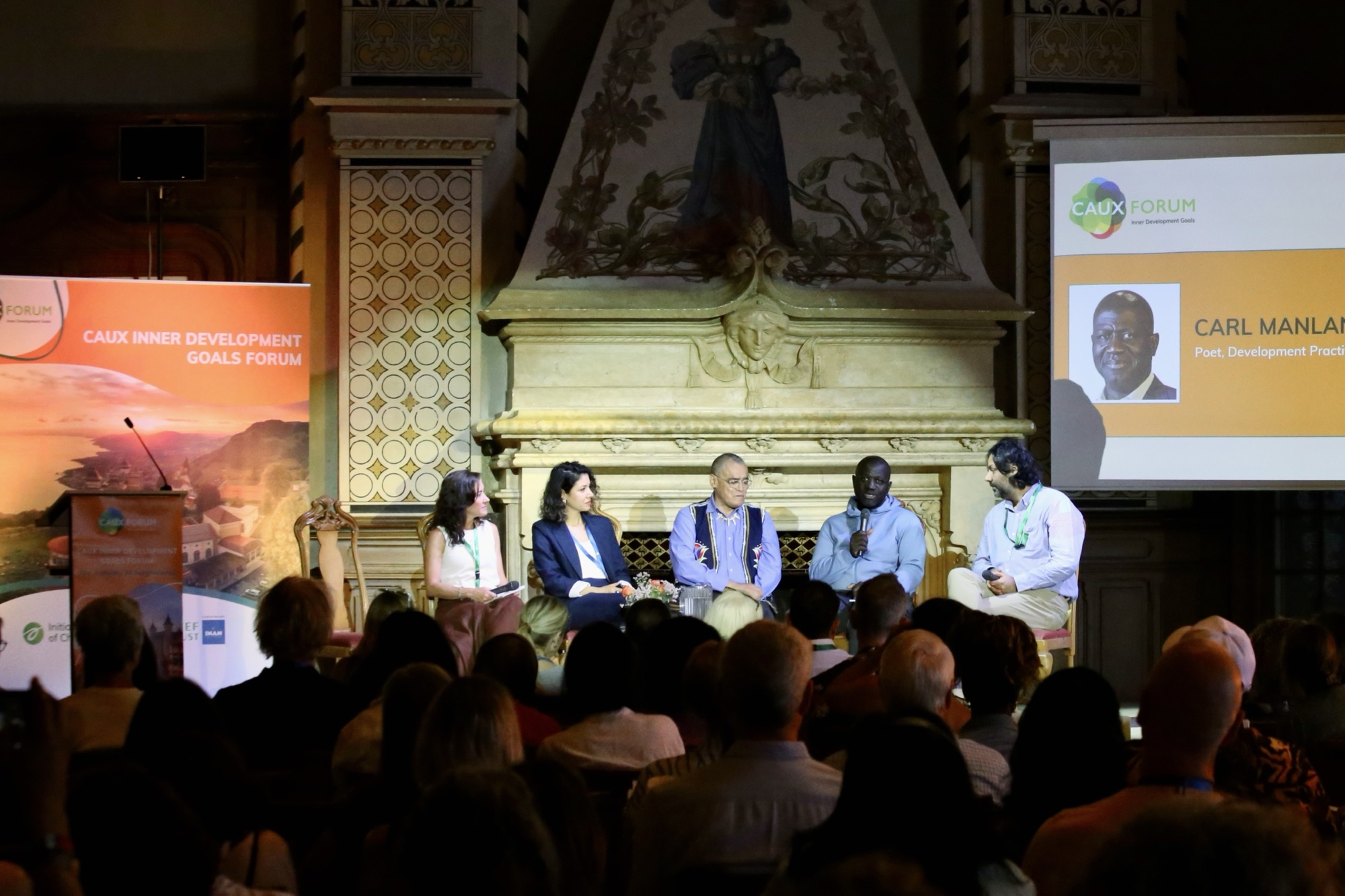
On the opening panel, speaking about loss and the journey through it, I read the first poem in the collection. It returns to the moment preceding grief being baptised. Before we are taught what to do with it. The poem lands where all grief begins: in the primary container we have – our body – before the words arrive.
The four principles that have animated this community for generations are not abstract virtues. When held against the experience of losing someone, they become something far more urgent: questions we must answer from the inside.
Unselfishness
Grief, in its early days, is one of the most selfish experiences a human being can undergo. Not selfish in the moral sense, but in the structural sense. It collapses the world inward. Everything becomes about the absence. Every room holds the wrong person. Every meal is eaten in the wrong company.
And yet – as the poems in i can breathe slowly taught me – grief eventually demands that we give something forward. It asks us to stop holding the loss as ours alone and begin offering what we have learned from it. That realisation comes when we no longer ask “why me?” and simply accept that the path we were given had loss upon it. It is a reminder to others who are still walking at dusk that it is possible to light the path from inside.
Unselfishness in the context of grief is not about diminishing your own loss. It is about understanding that your loss is also a form of knowledge. Knowledge, shared honestly, becomes a gift.
I went to Caux because I believed the fellow travellers sitting in that circle were carrying losses of their own. My offering was not expertise. It was companionship. It was journeying together.
Purity
Purity is perhaps the most misunderstood of the four absolutes. It is not cleanliness. It is not the absence of mess. Grief is one of the messiest human experiences. It does not arrive in neat stages, resolve on a schedule, or respect the boundaries we try to set around it.
There is, however, a kind of purity that grief can teach us if we are willing to learn. It is the purity of motive that emerges when everything performative has been stripped away. Sitting with loss leaves no audience and no engineered version of yourself to manage. There is only what is true.
i can breathe was written in that stripped-back place. I did not write it to be a poet. I wrote it because the loss I was carrying needed a form. Purity meant arriving at Caux not merely to deliver a session, but to be genuinely present with what grief has made of me. To hold space for what it has made of others. It meant bringing my full, unperformed self into the room so that we can embrace who we are in order to step into what we are becoming.
Honesty
This is the one that costs the most.
Grief asks us to be honest about things we would rather not say aloud:
– That we did not always love as fully as we could have.
– That we were sometimes absent when presence mattered.
– That forgiveness, the very heart of this year’s Forum, is not only something we extend to others.
Sometimes the harder work is forgiving ourselves for the imperfect, incomplete, very human way we loved.
For men, this honesty carries a particular weight. We are taught early and reminded that grief is to be contained, that tears signal structural weakness, and that strength means silence. At the closing of the opening panel, I read a poem about masculinity and grief. Picture the soul’s bladder holding tears until the solo flight home, about upholding tradition on earth while drowning privately in sorrow.
The room recognised it instantly. Not because it was unusual, but because it was true and rarely said aloud.
The Caux tradition holds that honest conversation must include everyone, affirm the best rather than confirm the worst, and look for what is right rather than who is right. That is also what I ask of poetry: neither to sentimentalise loss nor to resolve it prematurely, but to tell the truth about what it feels like from the inside. The hollow early days, the slow and surprising continuation, and the grief that does not end, but learns, over time, to share the space with life.
I went to Caux because I believe honesty about grief is one of the rarest and most necessary things a room full of people can practise together.
Love
Finally, love. Love is where grief begins.
The thread running through all four of these principles is simple: grief is not the opposite of love; it is love’s other face. We do not grieve what we did not love. The depth of the loss is the measure of the attachment. Learning to live with grief, to truly live with it, not around it or beneath it, is a way of honouring who or what we love. Grief does not put a full stop to love. It is a tango, and as one peer in our circle put it, sometimes we simply choose to turn our back to our partner for a moment.
The four principles were always intended as tools for individuals to confront inner motives and effect outer change. The most crucial inner motive to confront regarding grief is the impulse to close too quickly. To hastily declare the loss processed, the wound healed, and the chapter closed.
Love, held honestly, resists that premature closure. It lingers because the person mattered. The loss changed me, and I cannot pretend otherwise.
The workshop’s closing poem returned to this reality: that who or what we love still lives. Not in false comfort or fantasy, but in the way love reshapes us permanently. It is in how the people we have lost continue to inform what we notice, how we see, and how we love the living.
Breathing
I went to Caux because, more than 20 years ago, I met someone who saw a deep resonance between my work and the alchemy of forgiveness. When I first wrote this book about grief, I did not know it was also a book about forgiveness.
I went because the room above Lake Leman, filled with people from across the globe, is exactly the kind of place where that discovery can happen again. It is a space where our body – the primary container of our stories – can undergo an alchemy with us walking out into the Swiss evening carrying something we did not arrive with.
That is what the alchemy of forgiveness looks like from where I stand today. Not a transformation that erases the loss, but one that turns it, slowly, into something we can offer to the world.
Carl Manlan is the author of i can breathe (2025), a debut poetry collection on grief, memory, and renewal. He facilitated a workshop at the Caux IDG Forum 2026 titled “What We Love Still Lives: Poetry, Grief, and the Inner Work of Forgiveness.”
Back To All