The strawberry and the street trader: chasing the missing corridors of African ingenuity
SHARE


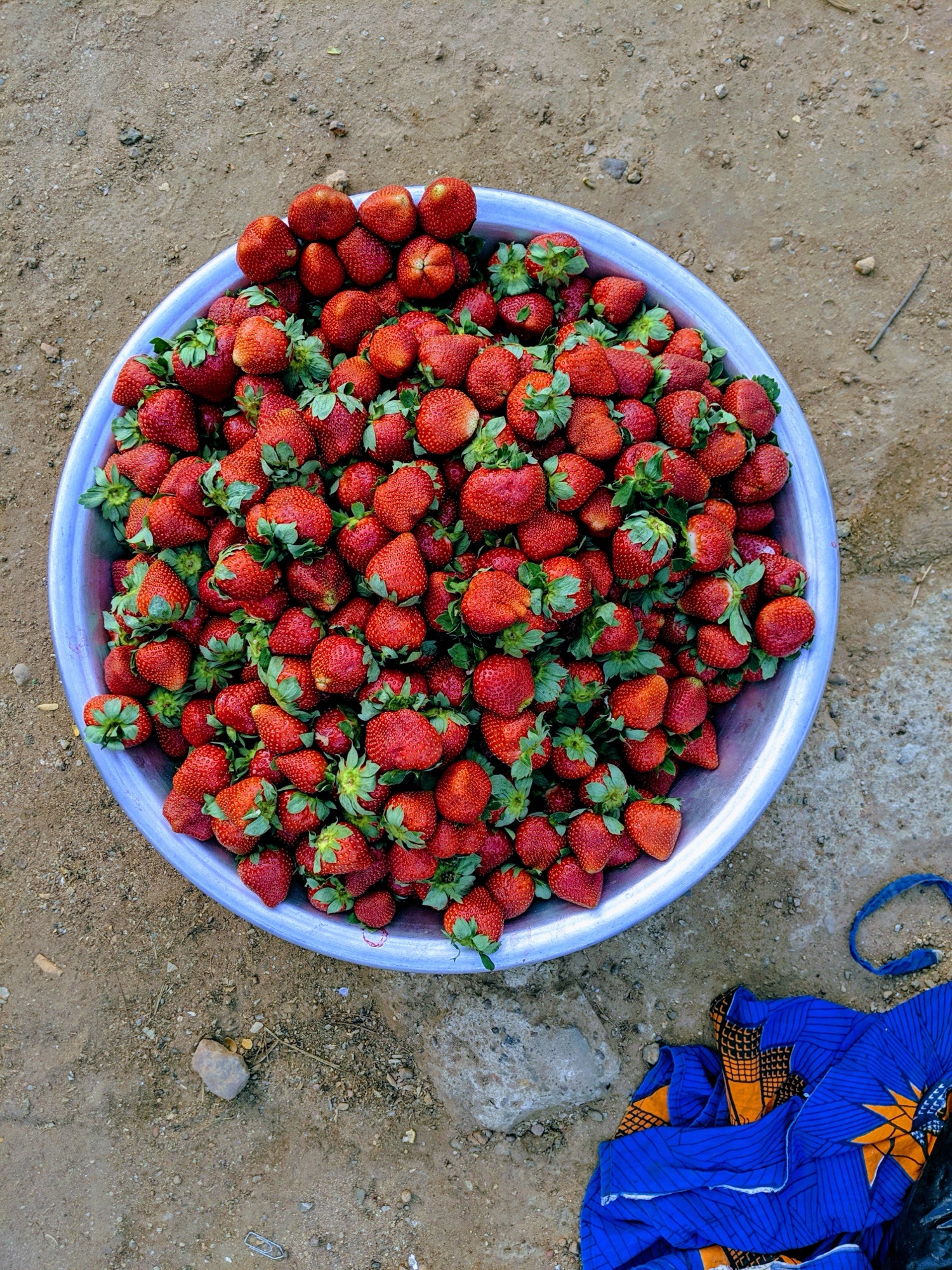
In 2019, I went to Burkina Faso to attend FESPACO. Beyond the poulet bicyclette, I had strawberries from Burkina Faso. A discovery at the tender age of 40+, not the country or strawberries but the fact that Burkina Faso produced strawberries.
As I continue to navigate the food systems world, I could not help but wonder, as I was preparing for my presentation in Paris, what supply chain did not connect those strawberries to Abidjan, where I grew up. Yet I had berries from France. Equally delicious, yet inaccessible to me. I wonder whether the treat I received from time to time would have been more frequent, had Ouagadougou been closer to my table than Paris.
That question sent me back, further than I expected, to a window I looked through as a child, long before I knew what a supply chain was.
The window
Every weekday, on my way to school, I observed the creativity of street traders. The glass window of the car I rode in was another type of education. I’d see the newspaper seller holding stacks of news for my parents. The gbaka conductor hailing passengers to Adjamé, holding on to the door as the driver manoeuvred through traffic. The aunties selling food at busy intersections for pupils, students and all alike. I was a stranger to what they were doing, in my own city.
I did not question the line my parents drew: my job was to do well at school so that I did not become like those outside our window. Yet even as they were held up as my cautionary tale, I was fascinated by their negotiation skills, their selection of goods, their adaptation to weather and to sports events. It took some of them a mere sixty seconds to trade. They understood their market. There was a method to it. The newspaper seller and others rotated, timing their sales to the rhythm of traffic and, at times, sprinting like Olympians to collect their cash.
I did not know it then, but what I was watching was supply chain management, practised with no classroom and no textbook, only creativity.
What the strawberries revealed
That is the same gap I met again in Ouagadougou, decades later, holding a punnet of Burkinabé strawberries and realising I had never once seen them growing up in Abidjan.
What struck me later is that this was never a story about whether the soil or the skill existed. Burkinabé growers have been cultivating strawberries around Ouagadougou since a French expatriate planted the first few stems in his garden in the 1970s. Today the country leads the region in production, harvesting roughly 2,000 tons a year and earning the fruit its local name, “red gold,” for the margins it delivers to growers and sellers alike. More than half of the crop is now exported, with Côte d’Ivoire among the neighbouring markets that receive it.
The corridor to Abidjan exists, or is beginning to. Yet, somewhere between the field and my childhood table, a corridor was missing. Certainly not a corridor of taste or of soil, both of which clearly existed, but a corridor of logistics, financing, and cold chain. France had solved that corridor for its own strawberries long before Burkina Faso could solve it for its neighbours. Not because French strawberries travelled a shorter distance, but because someone had already built the roads, the storage, and the financing that let them travel at all.
Roads and cold storage get financed once someone already loves what they’re moving. France did not build that corridor because strawberries are a rational commodity; it built it because strawberries were already woven into what a French table expects of itself. A corridor is infrastructure with a feeling behind it as nobody finances the first mile for a fruit they haven’t yet decided a market wants.
It is the same absence I now recognise in the street traders of my childhood: not an absence of skill, but an absence of infrastructure and data built around the skill they already had. The hawker who knew exactly which corner sold best in the rain. The newspaper seller who never moved from his light because he understood footfall better than any consultant. The mother who timed her scarf-selling to the exact seconds a light stayed red. They had mastered the art of variation, the vocabulary of bargaining, an intuitive grasp of a market before I encountered the term “market” in any textbook. What they lacked was the connective tissue encapsulated in one word: infrastructure. The roads, the financing instruments, the cold storage, the data systems that would have let their trade travel further than the length of a traffic light.
The first mile, twice over
Africa’s $100 billion food import bill is not, at its core, a story about what the continent can or cannot grow. Burkina Faso grows strawberries. My own family bought them from France instead, because someone, somewhere, had already built the last mile for French strawberries to reach a shelf in Abidjan, while nobody had yet built the first mile connecting a Burkinabé farmer to that same shelf. The street trader I watched as a child faced a miniature version of the same problem: he had already solved the “first mile” of knowing his customer, his timing, his product mix. What was missing was everything after that. The systems that would have let his instinct scale.
The food import bill is also about reducing loss. Doing so is simultaneously adaptation and local income generation. Resilience finance and commercial logic point in the same direction. So the fruit a woman, balancing a metallic bowl on her head, leaves behind because the day’s heat won’t let her carry more is avoidable economic loss.
I have spent much of my working life since then chasing that missing middle: the space between what informal genius already knows and what formal systems refuse to count. It is why I no longer see the hawker at the traffic light and the smallholder farmer as separate figures. Both are running the original family business. Both are practising a form of trade sophisticated enough to be studied, yet informal enough to be dismissed. And both are, in their own way, waiting for a version of the strawberry corridor that already exists for someone else, somewhere else.
Never the end
My introduction to trade was seamless, through a car window. My introduction to its limits came years later, through a punnet of strawberries in Ouagadougou. Between the two sits the same unfinished work of building the corridors: physical, financial, emotional and informational. The ones letting African produce and African ingenuity travel the short distance from where they are made to where they are needed, instead of the long one from where they are already valued.
We are always learning. Blended learning means we can source it from wherever it adds value being a traffic light in Abidjan, or a strawberry field outside Ouagadougou.
Back To All